
[youtube=http://www.youtube.com/watch?v=nINA8zGT538&hl=en&fs=1&rel=0]
After a long Fourth of July weekend, the Teens in East Palo Alto came back ready to be set off like the fireworks in their city’s streets on Saturday night. They came back strong and ready to work in a Week 3 that was exceptionally interesting to say the least.
On Wednesday, when half of the group traveled up to San Francisco to assist the teens in SF with interviewing SF District Attorney Kamala Harris, the other half put in work in EPA interviewing UC Santa Cruz Professor Emeritus in Sociology, John Brown Childs. In this interview on national/regional peace, Professor Childs gave us a brief history of his family, their connection to the Iroquois and Haudenosaunee tribes and how his family’s ideals and those of these Native American tribes directly relates to his theory of Trans-communality. He also gave EPA Teen Mural Assistants an introduction to the power of their thought and what it means to have inner peace; a topic the teens will be discussing in their final week of research.
This interview with Prof. John Brown Childs (video clip above) was perfect for supporting the teens in their research of this summers theme of PEACE. Prof. Childs, who was so loved by the teens, enjoyed himself just as much and has agreed to come back during the week of Inner Peace to discuss his theories. Here are a few notes from Prof. Childs’ interview:
His mother’s family is Native American. They belonged to a Massachusetts tribe who created a refuge for Native Americans to live in peace. His father’s family is African-American. His fathers ancestors created one of the first schools for African American children in the south after the civil war. He wanted to honor his ancestors in his work by teaching about both sides of his Ancestry. In both sides of his family, they were concerned about education and keeping peace in the community. He always sees education as a necessary tool for any community and its peace keeping efforts.
His theory of Trans-communality essentially means across communities. With this ideal, community to community, groups of people can maintain their own identity but live together harmoniously. The key here is respect for difference. Opposed to the melting pot theory which means that we melt our identities and assimilate into one identity. Trans-communality recognizes the differences and allows people to live together peacefully.
“When the Peacemaker said that thinking will replace violence. He knew that we needed to control our emotions via the management of our thoughts. He had a whole ceremony of sustenance to encourage rationale thought. It is called the condolence ceremony. This is really about inner peace.”
“It is important to have ceremonial moments. It does not have to be super formal but, life is so full of tension, problems and worries that having a moment to chill is very important. Even if its just for one moment. It is useful because it reminds the body and the mind that it can be at peace. ”
When asked “How can youth get their voices heard?” Prof. Childs mentioned that what they are doing in the Teen Mural Program is a great way to make their voices heard and that art and culture are one of the main ways to really send a message. He said that we all have different strengths. He mentioned that he is a writer and he contributes to society via this strength. “We all have one strength.”
This interview was certainly one of the best to date as the teens were fully engaged, interested and questioned almost everything that Professor Childs had to say. We were truly grateful to have him visit with us as we were all moved by what he had to say and are looking forward to having him back on the 22nd for an Inner Peace workshop!
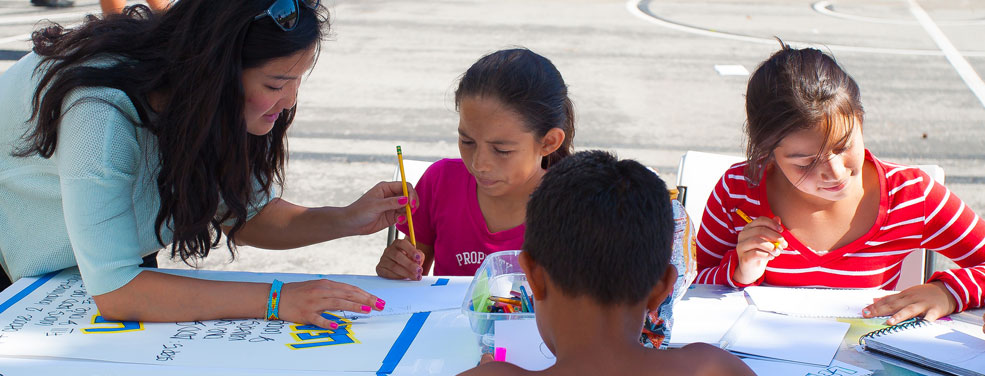
The Teens finished off week 3 with an art activity where they were able to revisit scaling by using pictures of two highly influential peace keepers, Martin Luther King Jr. and Gandhi. This was a head start in the right direction as teens are now thinking about who/what they would like to see in their mural and how will these images be depicted. A brilliant idea by our EPA resident artist, Laura Nagle, a workshop that nearly perfected their ability to scale a drawing and really recreate masterPEACE!